Engineer & fabricate
Finalize the vessel, frame, cooling, power, and instrumentation designs. Manufacture the hull and recoverable support structure.
Help us build, submerge, and test a real freshwater computing prototype.
Small enough to start. Built to learn.
01 /THE IDEA
Before a full-scale ocean data center, we need to prove the fundamentals.
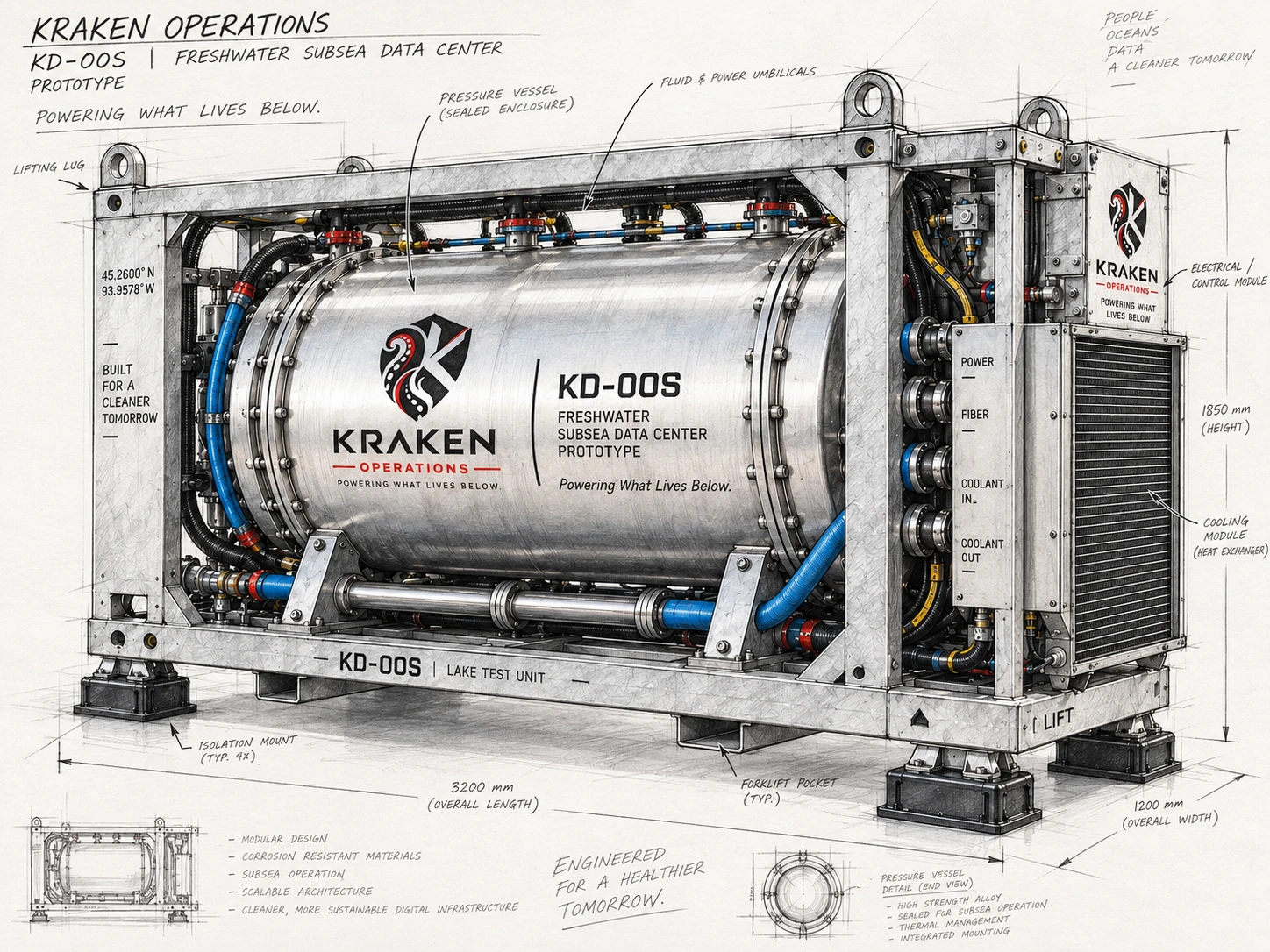
KD-00S is our proposed 4 × 8 ft freshwater subsea computing demonstrator. The plan: put 2–4 enterprise servers in a sealed, dry pressure vessel, connect them to shore power and fiber, and monitor how the system performs underwater.
We’ll build it. Test it. Submerge it. Run it. Then recover the whole system and document what we learn.
02 /HOW IT WORKS
A closed cooling loop carries heat from inside the pressure vessel to an external freshwater heat exchanger. Lake water never contacts the computers.
CONCEPTUAL THERMAL ARCHITECTURE / PERFORMANCE AND ENVIRONMENTAL EFFECTS TO BE TESTED
03 /THE PLAN AFTER FUNDING
A staged research program, with engineering review and testing before deployment.
Finalize the vessel, frame, cooling, power, and instrumentation designs. Manufacture the hull and recoverable support structure.
Install the servers and telemetry. Run controlled dry tests, followed by pressure and leak testing.
Target a controlled 3–5 m freshwater test. Run real workloads while recording temperatures, humidity, coolant flow, pressure, and leaks.
Retrieve and inspect the system. Share the operating data, failures, repairs, corrosion, fouling, and lessons learned.
Open development. We intend to share engineering progress, test results, setbacks, and repairs. Learning what fails is part of building what comes next.
04 /WHERE THE MONEY GOES
The proposed $75,000 budget covers engineering, hardware, fabrication, testing, and deployment—not a production-ready data center.
Donated equipment or services could free more funds for engineering, instrumentation, testing, and extended underwater operation.
PLANNED ALLOCATION / SUBJECT TO ENGINEERING CHANGES| Use of funds | Target |
|---|---|
| Pressure vessel engineering & fabrication | $20,000 |
| Structural frame & ballast | $7,000 |
| Servers & compute hardware | $8,000 |
| Cooling & heat exchanger | $7,000 |
| Power, fiber & penetrations | $6,000 |
| Sensors, telemetry & controls | $5,000 |
| Testing & deployment | $5,000 |
| Site work, permitting & logistics | $4,000 |
| Campaign fees, rewards & contingency | $13,000 |
| TOTAL CAMPAIGN GOAL | $75,000 |
05 /BE PART OF THE FIRST BUILD
The campaign is being prepared. Explore the planned backer levels below; pledges and payments are not available yet. Backing the project supports experimental research, not the purchase of a finished subsea system.
Your name in the KD-00S digital mission log.
Digital engineering artwork, Kraken wallpapers, and project updates.
Founding Crew rewards plus a Kraken Operations / KD-00S sticker pack.
A numbered KD-00S technical blueprint print plus prior rewards.
Recognition on the KD-00S mission page and deployment record.
A private final-testing / deployment livestream invitation and recognition on the project plate.
Major supporter recognition on our website and a virtual post-deployment engineering briefing.
Planned rewards are subject to the final campaign terms, availability, and fulfillment arrangements. No delivery dates are promised on this page.
We’re also seeking technology partners for servers, networking, cooling, power, instrumentation, pressure-vessel fabrication, and testing.
Partner inquiry details
Coming soon
06 /BEFORE YOU BACK
The image is a concept rendering of the system we want to build. KD-00S is a research prototype program, not a finished commercial product. Final construction and specifications will depend on engineering review and testing.
Engineering changes, fabrication delays, cooling redesign, leaks, component failures, permitting delays, biofouling, and schedule changes are possible. Deployment is planned only after appropriate engineering review and testing.
No deployment date is committed yet. The proposed sequence is engineering, fabrication, systems integration, dry testing, pressure and leak testing, then a controlled freshwater deployment.
A small, controlled freshwater test lets us investigate pressure integrity, cooling, condensation, networking, monitoring, and system recovery before pursuing larger ocean infrastructure.
Potential contributions include donated or loaned hardware, engineering samples, discounted equipment, technical guidance, fabrication, and testing services. Partner names and logos would be used with approval; participation does not imply certification or endorsement of the experimental system.